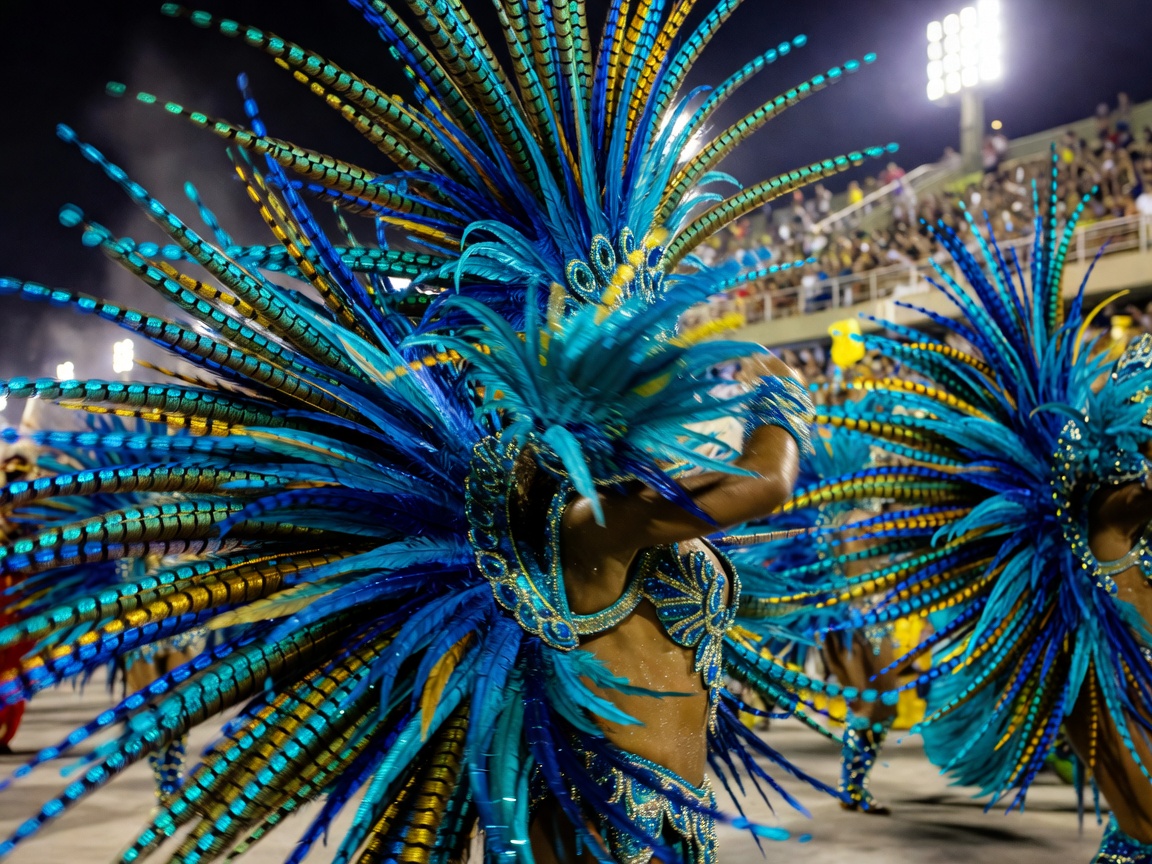
Filming the famous Sambadrome during the peak of Rio de Janeiro’s carnival presents unique technical challenges for visual documentarians. The overwhelming combination of stadium-strength floodlights, hyper-energetic dancers executing up to 180 foot-steps per minute, and massive moving floats demands meticulous camera sensor optimization.
High-Frame-Rate Capture Dynamics
To record the intricate physics of hand-woven feather headpieces and sequin embellishments, our film team utilized a dual-cinema setup shooting at 240 frames per second in 4K resolution. At 240fps, shutter speed must be fixed at a minimum of 1/500th of a second to eliminate motion blur, requiring camera sensors capable of pristine ISO performance without structural image degradation.
Technical Rig Specifications:
- Primary Camera: Full-frame Cinema Sensor with Dual Native ISO (800 / 12,800)
- Lenses: 70-200mm f/2.8 Cinema Zoom & 35mm T1.5 Anamorphic Prime
- Shutter Speed: 1/500s fixed shutter angle
- Storage Media: High-speed 1.9TB CFexpress Type B cards
Lighting Adjustments in the Sambadrome Runway
Unlike controlled studio environments, the Sambadrome utilizes industrial sodium and LED floodlighting arrays along its 700-meter runway. This introduces micro-flicker anomalies when recording above 120fps. By fine-tuning the camera shutter angle to precisely match 60Hz power grid cycles, the production avoided scan-line flicker, capturing smooth color tones across the full dynamic spectrum.
Documenting the Percussion Batteries (Bateria)
Beyond visual aesthetics, tracking the *Bateria* rhythm section required synchronizing 32-channel directional audio arrays with slow-motion footage. Slowing down drum beat impacts to 10% normal speed reveals the remarkable physical precision of master percussionists controlling heavy surdo and caixa drums under intense heat.